

Win Your Florida Contractor Exam Appeal

I completely understand how devastating it can be to see a failing score after spending weeks prepping your Florida contractor exam reference materials. You have poured your heart, time, and money into this process, and coming up short feels incredibly unfair.
But here is the good news: a failing grade doesn’t have to be the final word. The State of Florida gives you a legal avenue to fight back. Let’s look at how to launch a successful Florida contractor exam appeal, challenge unfair questions, and protect your hard work so you can finally get licensed.
Key Takeaways
Act Fast on Results: If you fail any part of your Florida contractor examination, you must submit a formal post-examination review request to the DBPR or Pearson VUE within 21 days of receiving your score.
Challenge with Precision: You possess a legal right to challenge specific examination questions you believe are ambiguous or incorrectly graded, which can potentially overturn a failing score before you resort to retaking the Florida contractor exam.
Follow the Legal Roadmap: If your written challenge is denied by the Construction Industry Licensing Board (CILB), you have the right to file an appeal for a formal administrative hearing under Chapter 120, Florida Statutes, within 30 days of the final order.
My First-Hand Look at the Florida Contractor Exam Appeal
I know exactly how it feels to stare at a score report from the Florida Department of Business and Professional Regulation (DBPR) that falls just a few points short of a passing grade. You have put your sweat, tears, and weeks of study time into mastering the Florida building code, hammering down complex business practices, and organizing your Florida contractor exam reference materials.
But before you throw your hands up in frustration or immediately resign yourself to a costly Florida contractor exam retake, I want you to know that a failing score does not have to be the final word. The State of Florida provides a specific, legal path to fight back.
Through a formal Florida contractor exam appeal, you can challenge flawed test items, protect your hard work, and potentially secure your license without starting your study plan from scratch.
Let me walk you through exactly how to appeal FL contractor exam results, protect your rights under Florida law, and navigate the bureaucratic maze of the Construction Industry Licensing Board.
Understanding Your Right to a Post-Examination Review
When you do not get the passing score you need, your very first step is not a full-blown lawsuit. It is a formal post-examination review. Under the Florida Administrative Code and Chapter 120 of the Florida Statutes, every candidate who fails an examination developed by the department has a legal right to challenge questions they believe are flawed.
Crucial Deadline: Your formal post-examination review request must be received by the state or its testing company no later than 21 days from the release date of your original grade notification. If you miss this window, you forfeit your right to review that specific attempt.
The process depends entirely on how your specific license type and examination part were administered.
Computer-Based Testing (CBT) vs. Paper and Pencil Format
Most modern examinations—including the foundational Business and Finance exam and various trade knowledge examinations—are administered in a computer-based testing format via the department’s examination vendor, Pearson VUE. If you failed a computer-based examination, you must schedule your review directly through Pearson VUE and pay their established review fee.
However, if you took a specialized trade examination administered in a paper and pencil format (which is managed by Professional Testing, Inc. for certain technical trades), you must submit a specific construction post-examination review request form directly to the DBPR along with a fee of $35 per examination part.
What Actually Happens During a Review Session?
Only you, the applicant, are permitted to attend this session. You cannot bring your study guide, a cell phone, or a construction law attorney into the room with you. You will sit in a secure room and review the exact examination questions you answered incorrectly during your actual exam.
This is your prime opportunity to evaluate whether the questions were fair, if the testing company’s answer key was flawed, or if a question ran completely counter to current building codes or the Florida Statutes.
How to Formally Challenge Examination Questions
Sitting in the review room isn't just about figuring out what you got wrong so you can study better next time. It is a tactical mission to build your Florida contractor exam appeal. If you spot a question that is poorly written, historically outdated, or containing multiple correct answers, you have the right to challenge it on the spot.
Crafting a Winning Written Challenge
During your scheduled review session, you will be given an opportunity to write formal objections to the questions you missed. To make your case stick with the licensing board, avoid emotional complaints like "This question is too hard." Instead, stay professional and highly technical:
Cite the Reference Material: If a question on construction lien law or contract administration contradicts the approved Florida contractor exam reference materials, write that down explicitly. For example: "According to the Florida Contractors Manual, Chapter 3, page 42, the correct notice timeline is 45 days, making option B the mathematically correct choice over option A."
Expose Ambiguity: If a question regarding project management or trade knowledge can be interpreted two different ways because of poor phrasing, explain exactly why the wording creates a double meaning.
Point Out Code Updates: Florida updates its building codes regularly. If a question relies on an outdated version of the Florida building code and penalizes you for using current, legal construction practices, document it.
Waiting for the Board's Evaluation
Once you submit your written challenges at the end of the review session, they are sent to subject matter experts and the Construction Industry Licensing Board (CILB) for evaluation. On average, the response time to challenges is approximately four weeks.
Because examination content is highly confidential, you will not receive a detailed breakdown or an explanatory letter. The only response you will receive is a simple notification of "credit" or "no credit" for each challenged question. If the board agrees with your assessment, they will award you the points.
For candidates who missed passing by a meager one or two points, this formal challenge process can instantly flip a failing score into a passing one, clearing the path for your license application.
Navigating the Formal Administrative Hearing Appeal Process

What happens if the CILB reviews your challenges and issues a flat denial, leaving you with a failing grade? Since a candidate who fails a licensure examination is legally defined as a substantially affected party under Florida law, you have the right to escalate the matter to an administrative hearing.
Filing the Petition
If you choose to appeal the decision, you must file a formal petition for an administrative hearing before the Division of Administrative Hearings (DOAH). This petition must be received within 30 days of receiving the board’s final order or formal denial of your exam challenges.
The De Novo Hearing Experience
An administrative hearing is not a casual meeting; it functions much like a civil trial. It is presided over by an Administrative Law Judge (ALJ) and is conducted as a de novo proceeding, meaning the judge looks at the evidence completely fresh, without simply rubber-stamping the DBPR's prior decision.
At this stage, I highly recommend hiring an experienced administrative law attorney who specializes in DBPR contractor license defense. During the preparation phase, the state will assemble a completed file of your missed and challenged questions. On the day of the hearing, your defense team will have the opportunity to present expert witnesses, cross-examine the state's testing experts, and prove that the examination questions were fundamentally unfair, unlawful, or misgraded.
If the judge rules in your favor, they will issue a recommended order to the board to grant you passing credit for the contested parts of the examination.
Knowing When to Retake the Florida Contractor Exam Instead
While an appeal is a powerful legal weapon, it is not always the smartest or most efficient business decision. As a general contractor or specialized trade contractor, time is money. You must carefully weigh the administrative timeline against the path of a traditional florida contractor exam retake.
Comparing Your Options: Appeal vs. Retake
Factor | Formal Exam Appeal Process | Retaking the Florida Contractor Exam |
Average Timeline | 3 to 9 months (including DOAH hearings) | Next available testing slot (often within weeks) |
Financial Cost | Review fees plus potential legal fees | Exam fee each time paid to the vendor |
Strategic Benefit | Validates your score if you are 1-2 points away | Allows you to quickly bypass a deeply failed attempt |
Risk Factor | Must wait for official results; cannot retest during active appeal | Risk of facing a different set of trade knowledge questions |
The Golden Rule of Appeals
A great rule of thumb I share with our students at the Florida Construction Academy is simple: Look at the math. If you scored a 68% or 69% (where 70% is passing), pursuing a post-examination review and submitting targeted challenges makes complete sense. Correcting just one or two flawed questions saves you from rewriting an entire section of the exam.
However, if your score fell significantly lower, your time and energy are far better spent executing a targeted preparation study plan, reinforcing the material you have already mastered, and preparing to retake the exam.
Essential Rules for Retaking the Florida Contractor Exam
If you decide that a retake is your fastest path to becoming a licensed contractor in Florida, you need to understand the state's specific retesting framework, so you don't run into regulatory roadblocks.
Unlimited Attempts, with a Catch
The State of Florida allows candidates to take the exam as many times as needed to achieve a passing score. There is no mandatory statutory waiting period between your attempts, meaning you do not have to wait months just to step back into a Pearson VUE testing center. You can schedule a retake as soon as the system permits, provided you pay the required exam fee each time.
The Four-Year Expiration Clock
While Florida allows you to retake the exam as many times as necessary, you cannot take forever to pass all parts of the examination. Rule 61G4-16.009 of the Florida Administrative Code states that you are required to retake only the individual tests or parts on which you failed to achieve a passing score.
However, you must successfully pass all parts of the examination within 4 years of your very first attempt. If you pass the Business and Finance exam but spend more than four years trying to pass your trade knowledge examinations, your passing Business score will expire. At that point, all previous test scores become completely invalid, and you will be forced to take all parts of the examination all over again.
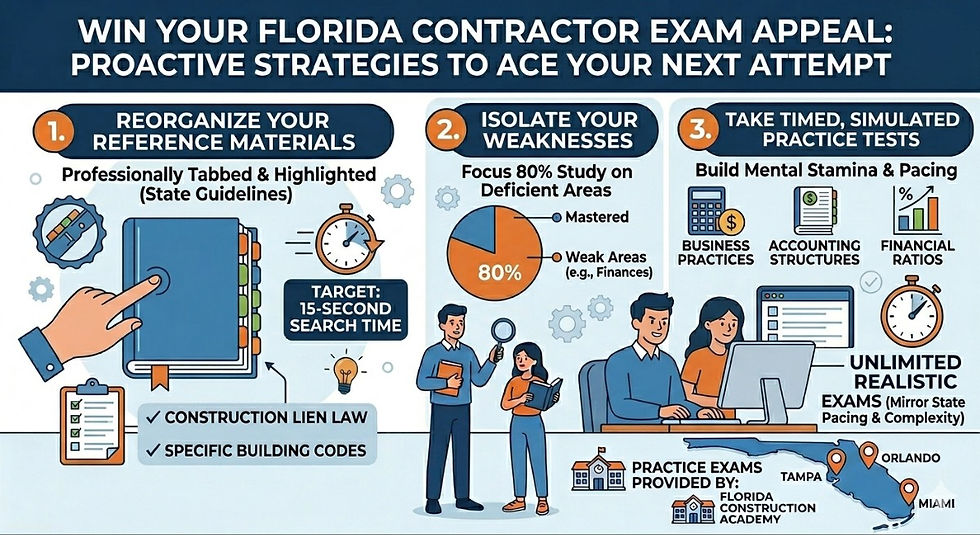
Proactive Strategies to Ace Your Next Attempt
Whether you are waiting on the results of a formal challenge or gearing up to retake the exam, success comes down to changing your approach. If you study the exact same way, you are likely to get the exact same result. Here is how to sharpen your strategy:
1. Reorganize Your Reference Materials
The Florida contractor exam is open book, but that is exactly why so many experienced tradesmen fail. They waste precious minutes flipping through unindexed pages. Ensure your books are professionally tabbed and highlighted according to state guidelines. You should be able to jump to the construction lien law section or specific building codes within fifteen seconds.
2. Isolate Your Weaknesses
Do not spend your valuable study time re-reading material you've already mastered. If you aced the project management and contract administration portions of the test but hit a wall on business practices, accounting structures, or financial ratios, dedicate 80% of your upcoming study hours exclusively to those financial hurdles.
3. Take Timed, Simulated Practice Tests
The biggest enemy on exam day isn't a lack of trade knowledge; it is the ticking clock. Train yourself under realistic, high-pressure testing conditions. At Florida Construction Academy, we provide unlimited practice exams that mirror the exact pacing, formatting, and complexity of the actual state computer-based examination. This builds the mental stamina required to stay sharp from the first question to the last.
Frequently Asked Questions
Can I still retake the exam while my formal appeal is active?
No. Under DBPR rules, candidates who review and submit formal challenges must wait until the results of those challenges are made official before participating in another examination administration. If you choose to register for and take a retake anyway, you will automatically forfeit your right to continue your active challenge.
What is the fee to request a post-examination review?
For computer-based examinations administered by Pearson VUE, the fee is paid directly to the vendor during scheduling and varies slightly by license type. For traditional construction paper and pencil examination parts managed by the department, the post-examination review request must include a fee of $35 per examination part.
How many points can I realistically gain through a written challenge?
While it varies depending on the specific exam pool, most successful challenges result in gaining 1 to 3 points. It is highly rare for the board to overturn a score by 5 points or more. This is why challenges are ideal for candidates who barely missed the passing mark.
Does a successful exam appeal grant me a license immediately?
No. Passing the exam is merely the educational benchmark. Once your exam score is updated to a passing status via your myfloridalicense.com portal, you must still complete and submit your formal license application, verify your required years of experience, demonstrate financial stability, and clear a background check before the CILB grants your active certificate of competency.
What happens if my passing exam scores turn four years old?
If you do not apply for initial licensure within four years of passing your examinations, those scores become entirely invalid. To become a registered contractor or certified contractor after that window closes, Florida requires you to apply for, pay for, and pass all parts of the examinations entirely over again.
Conclusion
Dealing with a frustrating exam score can feel incredibly overwhelming, but you do not have to map out your next steps alone. Whether you want to dissect your recent diagnostic report to see if an appeal is worth it, or you need a rock-solid study plan to guarantee you crush your upcoming retake, I am here to help. Let's get together and figure out the exact strategy to get you licensed. Reach out to us at Florida Construction Academy to schedule a consultation.


Comments